Free Live Webinar Series ● Thursdays • 3:00 PM CET • Q1 2026
A FREE 12-Week Series for DEPARTMENT Leaders USING the Microsoft Ecosystem
From AI Hype to AI Value in 90 Days:
Learn What Separates Pilots from Production
Each week covers a different function - Marketing, Sales, Field Service, Finance, and more - so you see what AI readiness looks like for your world.
The practical methodology for moving from "what's our AI strategy?" to agents in production, without rebuilding everything first.
One function per week.
Practical frameworks you can use immediately.
Each episode covers what AI readiness actually looks like for a specific department—the data requirements, the starting points, and the 90-day path to measurable results.
Episode 1 - AI Readiness & Value-First Thinking
Why readiness isn't about fixing everything—it's about knowing what to fix first
"We need to fix everything first" is the most expensive sentence in AI transformation. The companies already running agents in production didn't wait for perfect data or a new ERP. They got clear on value, cleaned what was in the path, and started.
In this webinar you'll learn:
Why readiness isn't about fixing everything—it's about knowing what to fix first
The V-A-D model: how to start with value, not technology
What "AI-ready" actually looks like (it's simpler than you think)
How companies who approach readiness systematically build agents 2.5x faster
The 90-day framework for getting your first agent into production
Episode 2 - The Agentic Toolkit
Declarative vs. autonomous agents: what they mean, when to use each, and which Microsoft tools fit which use case
"Agent" is the most misused word in tech right now. Microsoft, partners, the whole industry—everyone's using it differently. That confusion leads to failed pilots and wasted budgets.
In this webinar you'll learn:
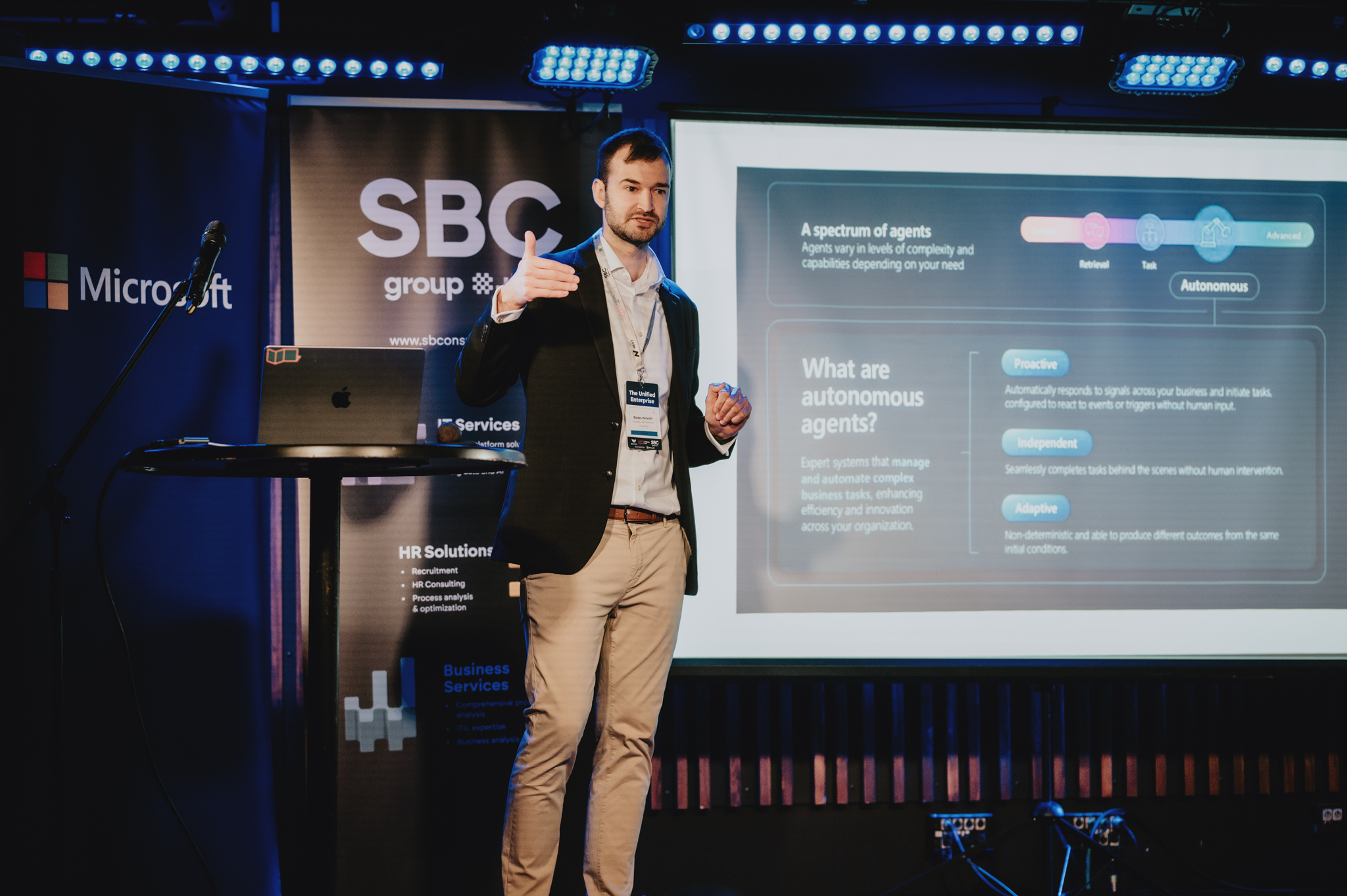
The spectrum of agents: from simple retrieval to fully autonomous
Declarative vs. autonomous: what they mean and when to use each
The 6 Microsoft tools for building agents—and which one fits your use case
Why Large Language Models aren't Large Mathematical Models (and what that means for hallucination)
How to match tool complexity to use case complexity—so you don't build in VS Code what you could build in SharePoint
Episode 3 - Marketing
Where AI creates real value in marketing and why autonomous AI often succeeds where adoption-dependent tools struggle
AI amplifies whatever you already have—good or bad. If your CRM data is a mess, AI will just make confident decisions based on that mess. If your customer journeys aren't mapped, AI can't optimize what doesn't exist.
That's why readiness for marketing isn't about fixing everything. It's about knowing what to fix for the specific use case you're deploying.
In this webinar you'll learn:
Where AI actually creates value in marketing—lead scoring, journey orchestration, content, churn prediction
What each use case needs to work (and what failure looks like when it's missing)
Why autonomous AI often succeeds where adoption-dependent tools struggle
The "clean the path" approach: how to start without waiting for perfect data
What ready looks like for your first marketing AI use case
Episode 4 - Sales
Why lead qualification is the highest-impact starting point and what CRM data quality actually needs to look like
81% of sales teams are experimenting with AI, but only 6% are seeing real bottom-line impact. The gap isn't the tools—it's what's already true in your CRM. The pattern we see repeatedly: companies that start with lead qualification, clean the data in its path, and get 90-day results before expanding are the ones still running AI a year later.
In this webinar you'll learn:
Why lead qualification is the highest-impact, lowest-risk starting point—and how to get measurable results in 90 days
The specific CRM data thresholds that matter (80% field completion, <5% duplicates) and what breaks when you don't have them
What Microsoft Dynamics 365 Sales and Copilot actually deliver out-of-box versus what requires Sales Premium licensing
How Salesforce Agentforce compares on autonomous agents—where Microsoft leads, where it trails, and what that means for your roadmap
The adoption problem nobody talks about: only 20% of reps use AI tools frequently, and the fix isn't training—it's workflow redesign
Episode 5 - Customer Service
Why companies seeing 315% ROI started with Copilot for agents, not chatbots for customers
85% of customer service leaders are exploring or piloting AI right now. But only 33% of organizations have scaled AI beyond experiments—and even among high performers, 70% are still struggling with data governance and knowledge base quality. The gap isn't the technology. The pattern we see repeatedly: companies that start with agent-assisted case summarization—where Copilot drafts responses and humans review—get measurable results in 90 days. Companies that jump straight to fully autonomous bots spend a year cleaning up hallucinations and rebuilding customer trust.
In this webinar you'll learn:
Why the companies seeing 315% ROI started with Copilot for agents, not chatbots for customers—and what that sequencing looks like in practice
What your knowledge base actually needs before AI can use it: the five dimensions (correctness, completeness, consistency, compliance, discoverability) and how to audit them
Where Microsoft's Copilot capabilities are genuinely strong versus where Salesforce, ServiceNow, and Oracle have an edge—and why platform choice matters less than data readiness
The three failure patterns that kill customer service AI projects: hallucinations that create liability (see: Air Canada), agent resistance that tanks adoption, and the "empathy gap" that drove Klarna to reverse course on full automation
How to structure a 90-day pilot that proves value—80%+ of cases using AI-assisted summarization, 20%+ reduction in handle time, CSAT maintained—before committing to autonomous agents
Episode 6 - Field Service
The 33-point gap in first-time fix rates traces back to data quality, not AI sophistication
93% of field service organizations say they've "partially implemented" AI. Only 3% have scaled it beyond pilots. The gap isn't the technology—it's what happens between the dispatch board and the van. The pattern we see repeatedly: companies that start with Copilot-assisted work order summarization—where AI drafts the pre-work brief and technicians add context—see adoption in 90 days. Companies that jump straight to autonomous scheduling spend a year fighting technician resistance and cleaning up missed SLAs.
In this webinar you'll learn:
Why the 33-point gap in first-time fix rates between top and bottom performers (86% vs. 53%) traces back to data quality, not AI sophistication—and what "AI-ready" work order data actually looks like
Where field service AI creates measurable value today: troubleshooting guidance that cuts resolution time by 39%, scheduling optimization that reduces travel by 23%, and IoT-triggered maintenance that prevents 70% of breakdowns
What breaks most field service AI projects: 70% of failures are people and process problems, not algorithm problems—and why technician trust is the constraint nobody budgets for
How Microsoft Dynamics 365 Field Service compares to Salesforce, SAP, and Oracle on AI capabilities—what's GA, what's preview, and what's marketing
The specific starting point we recommend: work order summarization via Copilot, why it requires the least data cleanup, and what "done" looks like in 90 days
Episode 7 - Procurement
Why invoice processing is the right first use case and how to achieve 65-75% touchless rates in six months
92% of CPOs are assessing or planning GenAI capabilities. Only 4% have scaled it to create real value. The gap isn't the algorithms—BCG's research shows 70% of AI success comes from people and processes, 20% from technology, and just 10% from the algorithms themselves. Yet most procurement AI initiatives flip that investment ratio entirely.
In this webinar you'll learn:
Why invoice processing automation is the right first use case—and how organizations achieve 65-75% touchless rates within six months while building the data foundation for everything else
What "supplier master data quality" actually means for AI readiness: the specific fields, formats, and governance that need to exist before spend analytics or risk monitoring can work
The pattern behind failed procurement AI: companies that deploy contract analysis AI on top of scanned PDFs in shared drives, then wonder why the AI hallucinates clause terms
How Digital Masters achieve 3.2x return on GenAI investments versus 1.6x for followers—and what they do differently in the first 90 days
The Microsoft D365 capabilities that are already generally available (Invoice Capture, Copilot-assisted PO management, Vendor Summary) versus what vendors are still announcing for 2026
Episode 8 - Supply-chain
Why demand forecasting is the highest-ROI starting point and how improvements cascade downstream
Supply chain AI failures aren't usually algorithm problems—73% trace back to data visibility gaps. Companies that invest in data infrastructure before launching AI initiatives see 3x better ROI than those that don't. The pattern we see repeatedly: organizations running scattered pilots across inventory, logistics, and planning simultaneously, while the companies getting real value picked one high-impact area—typically demand planning—cleaned the data in its path, and built from there.
In this webinar you'll learn:
Why demand forecasting is the highest-ROI starting point—and how improvements there cascade to inventory, logistics, and order promising downstream
What "data readiness" actually means for supply chain: the specific master data, transaction history, and real-time feeds that AI needs to function
The model drift problem: why 91% of ML models degrade over time, and what continuous monitoring looks like in practice
How Microsoft Dynamics 365 Supply Chain Management's Copilot capabilities compare to SAP, Oracle, Blue Yonder, and Kinaxis—where Microsoft is strong, where it's catching up
A practical roadmap from data validation to AI-assisted demand planning with measurable forecast accuracy improvement
Episode 9 - Finance
Where AI works in finance versus where hallucination risk makes it a liability
Finance is the one function where AI's fundamental nature creates a real problem: AI is probabilistic, and finance requires certainty. Every other department can tolerate some approximation. Finance can't—not when auditors, regulators, and your CEO's certification are on the line. That's why 59% of finance leaders say they're using AI, but only 1% have automated more than 75% of their processes. The gap isn't about technology. It's about finding the use cases where AI's strengths align with finance's constraints—and knowing exactly where they don't.
In this webinar you'll learn:
Where AI actually works in finance (invoice processing, cash forecasting, anomaly detection) versus where the hallucination risk makes it a liability
Why accounts payable is the right starting point for most finance teams—and the specific metrics that prove ROI within 90 days
What "human-in-the-loop" means in practice: which decisions AI can draft, which require approval, and which should never be automated
The data foundation that has to exist before any finance AI deployment—and the fastest path to getting there without a multi-year cleanup project
How to maintain audit trails and SOX compliance when AI is making (or suggesting) financial decisions
Episode 10 - HR
Why HR AI sits in a different regulatory category—and what August 2026 means for your roadmap
61% of HR leaders are actively planning or deploying GenAI—up from 19% eighteen months ago. But in Europe, only 19% of HR processes actually use it. The gap isn't skepticism or budget. It's that HR is the one function where the EU AI Act explicitly classifies most use cases as high-risk—and where a French court already halted an AI rollout mid-deployment because the works council wasn't properly consulted. The pattern we see repeatedly: companies that start with employee self-service—where AI answers benefits and policy questions, not hiring decisions—get measurable results in 90 days without triggering high-risk compliance requirements. Companies that jump straight to AI-powered recruiting spend a year navigating Article 22 restrictions on automated decisions and cleaning bias out of historical data they didn't know was problematic.
In this webinar you'll learn:
Why HR AI sits in a different regulatory category than every other department—and what August 2026 means for your roadmap
The three use cases where AI creates real value in HR (and the two where it creates legal exposure)
What your employee data actually needs to look like before predictive models work—and why historical hiring data often encodes exactly what you're trying to eliminate
How to engage works councils early enough that you don't become the next Nanterre case study
The 90-day starting point that builds organizational muscle for AI without triggering high-risk classification
Episode 11 - IT & Architecture
Why IT needs to prove AI works in their own operations before governing it for everyone else
IT is the only function being asked to do two things at once: adopt AI for your own operations AND enable AI for everyone else. Most organizations get the sequence wrong. They stand up governance committees and draft acceptable use policies while 60% of employees are already using AI tools IT doesn't control—and only 18% even know a policy exists. Meanwhile, IT teams themselves often haven't proven AI works in their own operations. The pattern we see repeatedly: companies where IT starts by running AI in their own house—help desk automation, Security Copilot for incident investigation—build the credibility and operational knowledge to govern AI for everyone else. Companies that skip straight to "enterprise AI governance" end up writing policies that employees ignore and that IT can't enforce.
In this webinar you'll learn:
Why starting with Security Copilot or help desk AI gives IT the operational credibility to become the enterprise AI enabler—and what "done" looks like in 90 days
What shadow AI actually costs: $670K added to average breach costs, 46% of organizations already leaking data through GenAI, and why acceptable use policies alone won't fix it
The specific data quality requirements that make or break IT AI: CMDB accuracy above 95%, 12-24 months of clean ticket history, and monitoring coverage across all infrastructure
How Microsoft's new Entra Agent ID addresses the shadow AI problem by giving IT visibility into every AI agent operating in your environment—sanctioned or not
The Center of Excellence model that works: when to centralize AI expertise, when to distribute it, and why 37% of large enterprises have already made this structural decision
Episode 12 - AI and Agentic Governance
The four governance layers that separate companies scaling AI from those drowning in technical debt
Most companies don't fail at AI because they picked the wrong tools. They fail because they ran nine departments in parallel, each building their own thing, until executives couldn't see value and shut down the budget. The pattern we see repeatedly: companies that scale AI have governance before they have agents. Companies stuck in pilot purgatory have agents everywhere and governance nowhere.
In this webinar you'll learn:
The four governance layers that separate companies scaling AI from those drowning in technical debt—strategy, architecture, operations, and security
Why "pilot purgatory" happens and how silo teams building AI in parallel create problems that cost more to fix than the AI saved
What a golden path actually looks like—a governed, repeatable way to go from idea to production that accelerates rather than slows down
How the 11 previous episodes connect: what governance means for Marketing, Sales, Field Service, Finance, and every function in between
Where to start if you have agents scattered across departments and no framework tying them together
Can't attend every week? Register once and get access to all replays.
Watch the episodes relevant to your role, skip the rest.
When Microsoft launched Copilot, every enterprise felt the pressure: show AI results before competitors do.
Most companies responded by buying licenses and running pilots. Some even declared themselves "AI-first."
But here's what we've seen:
Copilot for emails and meeting summaries isn't AI transformation.
Real AI - the kind that automates processes, connects systems, and delivers measurable value - requires operational readiness that most companies haven't built yet.
This series is where we close that gap by showing what readiness looks like for each department and how to get there.
Companies are paying for AI, running pilots, but can't connect the dots to business value
The problem isn't the technology, it's the foundations underneath.
Here's why:
Scattered data
Your data exists—but it lives in Excel files, email threads, and disconnected systems. AI can't work with information it can't access. Until your data is structured and connected, agents have nothing useful to act on.
No clear starting point
Leadership is asking for AI results, but operations teams lack a methodology. Without a proven framework, it's impossible to know which processes to automate first or how to prioritise limited resources.
Unmapped processes
Most workflows aren't written down, they vary by person and department. The problem: AI can only automate what's repeatable and well-defined. If a human can't follow your process documentation, neither can an agent.
Disconnected systems
Your CRM doesn't talk to your ERP. Field data lives separately from finance. AI's real power comes from connecting these systems to surface patterns across functions - but that connection doesn't exist yet.
This series will cover AI-readiness for every department.
You'll learn:
The Gap Nobody Talks About
Why companies with Copilot licenses still can't show business value. The readiness gap that's actually blocking progress - and the specific foundations you need to close it.
No New Licenses Required
How to activate what you already have. Which AI capabilities already exist in your Dynamics 365 and Power Platform stack and how to extract value without additional investment.
What 90 days to AI readiness looks like
Map the phases from disconnected systems to intelligent operations using proven implementation frameworks.
Skip the Custom Build
How baseline agents accelerate deployment
How to use Microsoft-native, pre-built agents to connect CRM, ERP, and field data without months of custom development.
Answer the Board
A framework you can actually defend to leadership. The three questions to ask before any agent project - and how to prioritise when everything feels urgent.
Free to attend. Join from anywhere.
Here's what you'll be able to do after this series:
Turn your Microsoft investment into measurable value
Activate AI features already in your stack and show tangible results without years of implementation or new platform purchases.
Connect fragmented systems without massive projects
Integrate CRM, ERP, and field data using baseline agents while others wait for custom development that never ships.
Move from AI experiments to business impact
Operationalise AI using proven frameworks while competitors struggle to move past ChatGPT prompts and demo environments.
Build operational readiness, not just AI adoption
Structure your data, processes, and systems for agentic AI while others remain stuck in perpetual pilot mode.
Build a clear 90-day implementation plan
Walk away with a roadmap and specific milestones, so you can answer "what's our AI strategy?" with something concrete.
About the Speaker
Balázs has spent 13 years implementing Dynamics 365 and Power Platform solutions—first at a Big Four in London and a global systems integrator, now as founder of VisualLabs.
His focus is on connecting siloed systems, structuring data, and documenting processes across ERP, CRM, and field operations. The kind of foundations that turn AI experiments into business results.
In this series, he shares the methodology VisualLabs uses with enterprise clients across the UK and Europe to close the readiness gap and move from pilots to production.

If your company runs on Dynamics 365 or Power Platform, this series is for
Operations
Leaders
Who need to show AI results but have field data in spreadsheets, processes that vary by person, and systems that don't connect.
You want a methodology you can own, not another consultant's roadmap that collects dust.
Digital Transformation Leaders
Who are under pressure to prove your Microsoft investment's business value but don't have a clear path from pilots to production.
You've seen enough AI demos, you need implementation frameworks that actually work.
CFOs & Finance Leaders
Who approved Copilot licenses six months ago and now can't show ROI. You're skeptical of "the next phase" because the first phase didn't deliver.
You need someone to validate that instinct and give you a structured path you can defend to the board.
About Visual Labs
VisualLabs is a Microsoft Solutions Partner specializing in helping mid-to-large enterprises with field operations turn their Dynamics 365 and Power Platform environments into AI-ready systems.
With clients across the UK, US, and Europe, the company focuses on the operational foundations—structured data, integrated systems, and documented processes—that make AI implementation possible.
VisualLabs has built baseline agents and a proven methodology to help companies move from AI experimentation to measurable business value in 90 days.